The Barossa is best known for rich red wines, above all Shiraz. Tourism Australia notes that the region is home to the world’s oldest continuously producing Shiraz, Grenache, Mataro, Cabernet Sauvignon and Semillon vines, and that its fortified wines are renowned as well. Up in the cooler Eden Valley, the signature varieties are Riesling and Shiraz. On a wine tour you can taste across all of them in a day, at small, family-owned cellar doors where you often meet the person who made the wine.
With more than 150 wineries and 80 cellar doors in the region (Tourism Australia), it helps to know what to look out for. Here is a simple guide to the wines you are likely to meet on a Barossa day.
Shiraz: the Barossa’s headline act
If there is one wine people come to the Barossa for, it is Shiraz. The South Australian Tourism Commission sums up a visit as a chance to “savour the shiraz” (SATC), and you will find it at almost every cellar door. Barossa Shiraz is usually generous and full-bodied, but styles vary a lot from maker to maker and vineyard to vineyard, which is exactly why tasting a few side by side is so much fun.
Ask at the cellar door about the age of the vines. Because the region has some of the world’s oldest continuously producing Shiraz vines, many makers are proud to tell you where and how old their vineyards are.
Grenache and Mataro
Grenache and Mataro (also known as Mourvèdre) are two more red varieties with very old plantings in the Barossa. You will see them as single-variety wines and in blends, often alongside Shiraz, which you may see labelled GSM. If you usually drink Shiraz, a Grenache is a good one to try next: it tends to be lighter in colour and body.
Cabernet Sauvignon
The Barossa is also home to some of the world’s oldest continuously producing Cabernet Sauvignon vines. You will find it on its own and blended with Shiraz, so it is worth asking for a taste if it is on the list.
Semillon and the whites
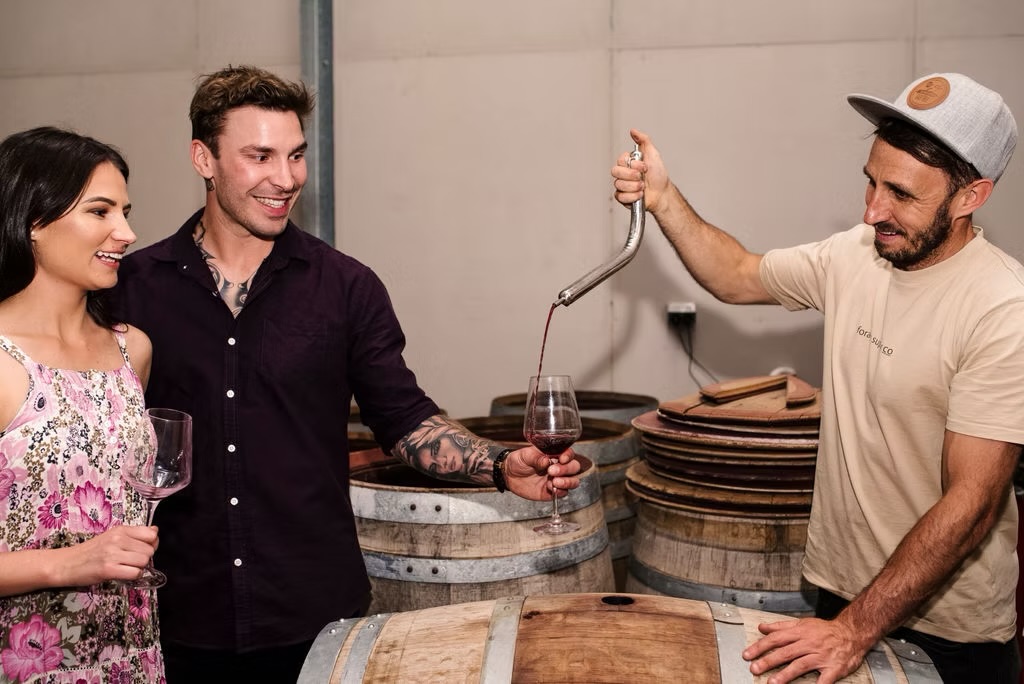
It is not all reds. Semillon is one of the varieties with very old vines in the Barossa, and many cellar doors open their tasting with a white or two. Eden Valley adds Sauvignon Blanc, Semillon, Chardonnay and Pinot Gris to the mix (SATC, Eden Valley).
Eden Valley Riesling
A short drive up into the hills from the valley floor, Eden Valley makes premium cool-climate wines, and its signature varieties are Riesling and Shiraz. According to the SATC, Eden Valley has a winemaking history dating back to 1847 and is home to some of the world’s oldest Shiraz and Riesling vineyards, with fifth-generation winemakers whose families go back to the area’s original settlers. If you enjoy crisp whites, ask Kirsty to include an Eden Valley cellar door in your day.
Fortified wines
Fortified wines are part of the Barossa story too, and Tourism Australia lists them among the region’s renowned wines. If a cellar door offers a fortified at the end of a tasting, it is a lovely way to finish.
Barossa Valley and Eden Valley in one day
You do not have to choose between the two. The valley floor and Eden Valley sit side by side, so a day can start with Riesling up in the hills and finish with Shiraz on the valley floor, or the other way around. Angaston, on the eastern side of the valley, is the natural link between them. Tell Kirsty if you would like both, and she will plan the order so the driving is easy and the tastings flow from lighter wines to bigger reds.
How to taste them on a Barossa wine tour
- Mix it up. Try a Shiraz at two or three different cellar doors to see how much the style changes.
- Ask questions. At small, family-owned wineries you can often talk to the winemaker about the vines and how the wine was made.
- Pace yourself. Tastings are small, but they add up. An Australian standard drink contains 10 grams of pure alcohol, and a glass of wine can be more than one (Department of Health). Spittoons are there for a reason.
- Take notes. A quick photo of the label helps you remember which wine you loved.
On our small-group tour you visit a minimum of four boutique wineries, and on a private tour you can tell Kirsty which varieties you want to explore and she will plan the cellar doors around them. Either way, door-to-door pickup is included, so nobody has to drive. Our wine tasting tips cover fees and etiquette.